
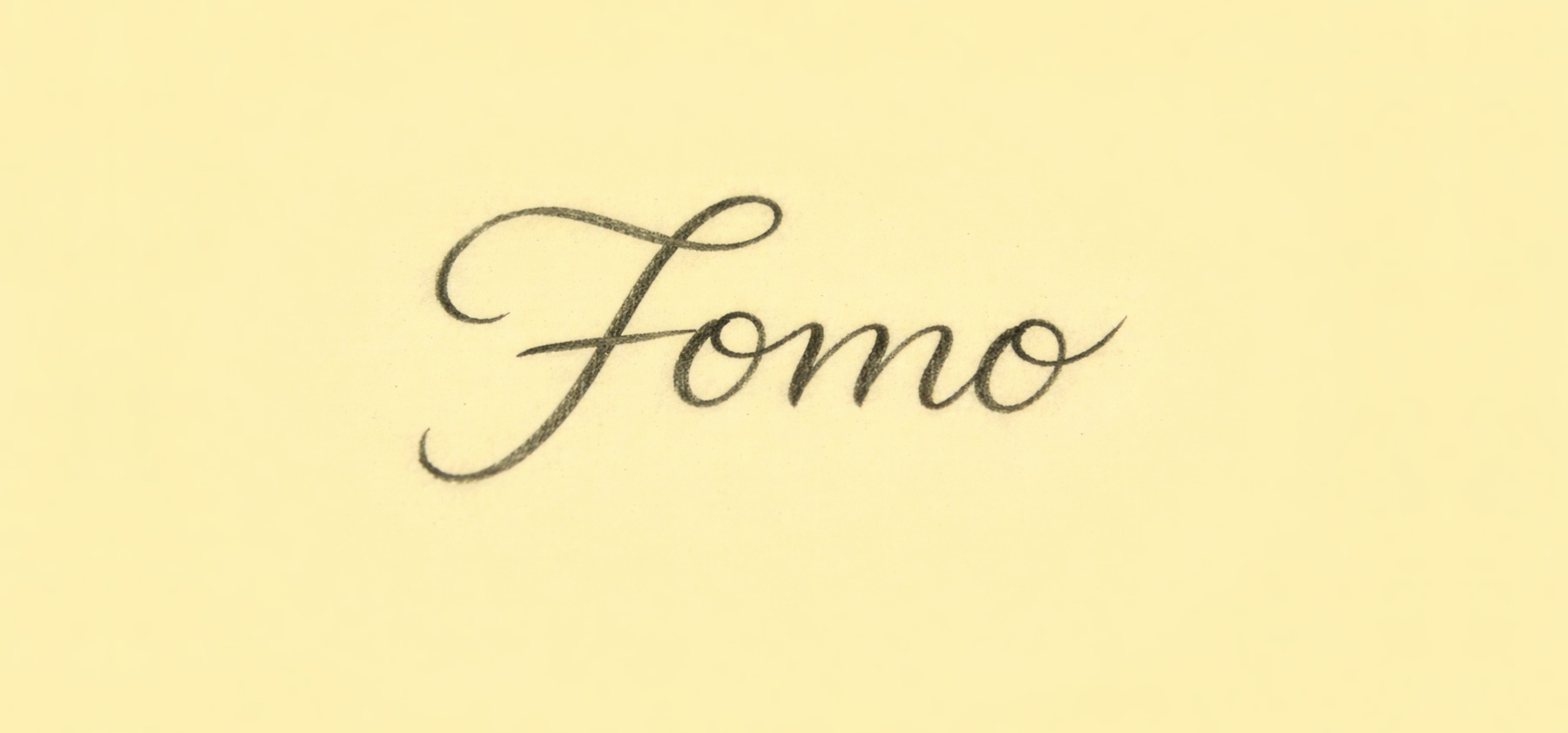
By Maxfield Mellenbruch
Not the more famous piece. Not the more valuable one. The one whose idea does more work.
A few days ago, FOMO 01/12 sold at Heritage Auctions for $10,980. It’s a signed yellow Post-it note from an edition I originally offered at $500, carrying a simple promise: send it back and I’ll pay you $1,000. I made twelve, sold ten to collectors, sent 01/12 to auction, and kept one for myself to hold long-term. Nobody has taken me up on the $1,000 yet, and after Heritage, I doubt anyone will. The first one to reach auction sold for nearly 22 times the original price, with the auctioneer literally invoking the fear of missing out named in the title.
Here’s the claim, and I want to be precise about it before I make it, because precision is the whole point. I’m not saying FOMO has the fame, the price tag, or the cultural weight of Maurizio Cattelan’s Comedian, the banana duct-taped to a wall that eventually sold at auction for $6.2 million. It doesn’t, and I don’t expect that to change. What I’m claiming is narrower: on the one question conceptual art exists to ask: what the idea is actually doing… I think FOMO does more of it. The better artwork, on that single axis. Not the greater one, and not the bigger story. That distinction is the argument, so I’ll keep coming back to it.
That $6.2 million figure isn’t what Comedian originally sold for. It debuted at Art Basel Miami Beach in 2019 as an edition of three, plus two artist’s proofs. The edition that eventually sold at Sotheby’s for $6.2 million had originally sold for $120,000. I’m bringing that up now, on purpose, because it changes the shape of this comparison: FOMO isn’t four months old and competing against a $6.2 million piece. It’s four months old and competing against a $120,000 piece that hadn’t been auction-tested yet either.
♦ What Each Piece Actually Needs to Keep Running
Comedian ’s object of record isn’t the banana. It’s a certificate with an instruction sheet attached: buy a fresh banana, duct-tape it to the wall at a specified height, replace it as necessary. That’s a real and interesting piece of design. A Comedian owner holding the certificate in storage still owns everything the piece actually is, the same way most blue-chip art spends most of its life in storage without ceasing to be the artwork.
What’s different isn’t whether Comedian continues to exist off-stage. It’s what the piece is doing while it’s off-stage. Comedian ’s meaning is built around a public act: buy the banana, tape it up, let people see it. FOMO ’s meaning doesn’t need a performance at all. A holder alone in a room, with no press, no gallery, and no active spectator, still faces the question: redeem now, or keep believing the note is worth more than the money.
That’s not a claim that FOMO exists outside society – the holder is still carrying Heritage’s auction result, my reputation, and imagined future buyers around in their head. The crowd hasn’t vanished; it’s been internalized. What matters here is that the specific thing FOMO asks of its owner requires no active audience to happen. No opening, no crowd – the decision runs on its own.
♦ Why This Counts as Art, Not Just Structure
It’s worth pausing here on why this is conceptual art and not just financial engineering with a signature on it. FOMO ’s material isn’t paper, and it isn’t even the promise. It’s a future decision that hasn’t been made yet, sitting unresolved in the head of whoever is holding the note.
A yellow Post-it is normally disposable, forgettable, administrative. Here it becomes a vessel for belief and a small machine for producing uncertainty and desire – banal and charged at once. That gap, between what the material is worth and what changes hands for it, is the same joke Comedian is built on. A banana is disposable too. Both pieces start from an object nobody would look at twice, and neither wastes effort disguising that.
There’s another reason the writing on the Post-it matters. The note itself is minimal: “I.O.U. $1,000,” numbered 01/12, signed MAXFIELD. It doesn’t describe an obligation. In J. L. Austin’s sense, it performs one. Writing “I.O.U.” and signing a name isn’t a report of a debt that already existed. It’s the act that creates the debt.
Comedian gives its owner a certificate and instructions for restaging a joke; its meaning can keep changing with the circumstances. FOMO ’s unresolved decision isn’t something left over after the work has done its job. It is the job. The next time a holder considers selling, redeeming, or simply keeping the note, the same question is waiting.
It also means the piece does something to the holder rather than describing something to a viewer. FOMO doesn’t just name fear of missing out; it gives the owner a reason to feel it, using their own money as the instrument. That feeling borrows from the logic of redeemable instruments: a fixed redemption amount sitting under a floating market price, promised value pulling one way and speculative value pulling the other, with no one to resolve it for them. That’s not a metaphor – for four months it’s been an actual small economy running on a Post-it note, with real financial stakes.
My signature and the note’s scarcity are why a market exists for it at all. The promise is why that market behaves the way it does: it creates an alternative to simply selling, and the market in turn makes that alternative harder to choose. Comedian presents a question about value and belief with extraordinary clarity. FOMO makes the owner participate in it.
♦ The Precedent I Can’t Ignore
None of this means FOMO invented financial conceptual art. Duchamp made bonds. Yves Klein built payment into his work. Lee Mingwei gave people money they could preserve as art or spend. The territory has history.
The closest precedent I found while researching this essay is Billy Apple’s I.O.U.s. I hadn’t looked for precedents when I made FOMO; I just made it. Finding Apple’s work afterward left me uneasy… close enough to raise a question I hadn’t thought to ask: how original was FOMO, really? But the deeper I looked, the more his structure and mine pulled apart.
Beginning in 1984, Apple issued I.O.U.s: real promissory notes with a gallery commission tacked on top that wasn’t repaid. The amount wasn’t fixed; it was negotiated per transaction. Redeeming one meant he repaid the borrowed principal but not the commission, economically a little like a return policy with a restocking fee. In decades of issuing them, Apple has said no one ever came back demanding repayment, which he attributed to the nonrefundable commission.
FOMO works differently, both in what it’s made of and what it promises. Apple’s I.O.U.s ranged from works on paper to large typographic canvases designed to live on a wall. FOMO compresses everything into a two-cent Post-it: the I.O.U., the number, and my signature, all written in pencil, identical in structure across all twelve, with the same $1,000 promise attached to each one. Apple’s redemption meant accepting a loss on the original transaction. FOMO does the opposite. For the original buyers, redeeming means turning $500 into $1,000 whenever they want.
Apple returned to the I.O.U. structure repeatedly over the course of his career. FOMO is different in that respect too. I made twelve, and I don’t plan to make more.
One more distinction matters. The $1,000 promise isn’t a personal arrangement with the ten original buyers; it travels with the physical note. Whoever holds it can redeem it, whether that’s one of those ten or someone who paid $10,980 for 01/12 at Heritage. I don’t know whether Apple’s obligation worked the same way if one of his I.O.U.s changed hands, and I don’t want to claim that it did or didn’t.
What interests me most, though, isn’t simply that money is built into the work. Duchamp’s bond, Klein’s exchanges, and Apple’s I.O.U.s all did that in different ways. In FOMO, a fixed $1,000 redemption amount sits beside a market price that can keep moving, leaving the holder with three choices: redeem, sell, or keep holding. That’s where the title stops being descriptive and becomes structural. The money isn’t just part of the transaction; it creates the pressure under which the holder has to decide what the work is worth.
I could have added a zero to both numbers and the mechanism would have been essentially the same. I chose $500 and $1,000 partly because I wanted the work to remain accessible to my collectors, but also because the numbers have an almost cartoon clarity: pay $500, get $1,000 back, or don’t. At a much higher price, the money itself might have started to overpower the idea.
♦ The Risk Comedian Doesn’t Face – and What Changed
Here’s the part I think is the real argument, and the one I’d stand behind hardest.
Comedian could fail the way most art fails – badly received, ignored by the market. But that’s a claim about resilience, not immunity. What Comedian genuinely doesn’t face is a specific financial promise from the artist to whoever owns it: no one bought a Cattelan with the right to hand it back and demand a fixed dollar amount. FOMO carries exactly that kind of obligation. If the auctioned note had come in at or below its $1,000 redemption price, the case for holding would have looked shakier and redemption newly attractive.
The money itself wasn’t the uncertainty. I could have honored every original buyer’s redemption without difficulty. What mattered was what a weak public result would say about the mechanism. A Post-it with no comparable sale could still fail to convince the market, no matter how carefully I’d set the conditions.
I wasn’t going in blind. The collector base and track record already existed, and the original buyers knew 01/12 was headed to auction that fall. The redemption promise gave them a reason to wait for that test. But belief isn’t certainty. At some point I was still asking people to take a literal yellow Post-it seriously enough to put real money behind it.
There was something broader in that for me too. Most of my earlier work gave people obvious material reasons to value it – engineering, fabrication, metal, gemstones, months of labor. FOMO stripped almost all of that away. Without making the auction a referendum on everything I’d made, I knew the result would tell me something about how far an idea and my name could carry a work once most of the object itself had been removed.
The note sold for $10,980.
That didn’t simply give FOMO a public price. It changed the decision facing every other holder. Before the auction, they were comparing the redemption promise to an unknown secondary-market value. After September 3, redemption meant giving up something whose first public sale had valued it far higher. Nothing on the paper changed, but the decision inside it did.
That’s the part I find most interesting: the market doesn’t merely judge FOMO from outside it. It changes the conditions inside it. A strong sale can make redemption harder to justify; a weak one could make it more attractive. The fixed promise stays where it is while everything around it moves.
That also makes FOMO recursive, because even this essay can enter the loop. If the argument persuades people the work matters, that can change what a holder thinks the note is worth. I’d rather admit this essay is self-promotional than pretend otherwise. I can’t fully tell, from inside it, whether I’m describing the mechanism or currently being used by it.
And the mechanism can move in either direction. If the market rises, the pressure not to redeem increases. If it cools, or a holder simply wants the cash, that pressure can reverse. Redemption doesn’t necessarily end anything either: a returned note could be held, resold, or released again.
I also don’t think I get to decide whether continued holding proves conviction or merely looks like the behavior of people inside a bubble. That’s part of the mechanism too. The work doesn’t resolve the question of what it’s worth. It keeps handing that question back to whoever owns it.
♦ The Objection That Gets Harder to Make
There’s a reaction conceptual art has never fully shaken, and Comedian gets it constantly: this is nothing, a child could do it, the artist is laughing at whoever pays for it. It’s the correct instinct applied to a real category of art-world behavior, where the joke really is on the buyer and the artist walks away with the money.
FOMO is harder to hit with that objection. The accusation works best when the artist takes money for something worth less than what was paid and gives nothing back. With the original ten buyers, I’m on the hook to pay more than they paid me the moment any one of them asks. That doesn’t make every question about the piece disappear. Whether I’ll honor the promise, what happens if confidence in the guarantee slips, and whether the work is any good are all fair. But it changes the shape of the usual insult. You paid me $500, and I’m offering to give you $1,000 back. How is that taking advantage of you?
The original ten buyers were in an unusual position from the start. The moment each bought a note for $500, they held my standing promise to pay them $1,000 whenever they wanted to redeem it, which gave them a reason to be patient, and all ten notes remained off the market leading up to the auction. There was little room for outsiders to argue they’d been taken advantage of. That quiet absence of backlash did real work: a project where the original buyer can walk away with more cash than they put in reads differently from one where the artist simply pockets the money and leaves the buyer holding the joke.
None of that means I can’t profit, and the auction shows I can. Profit and obligation just sit side by side. The $1,000 promise stays fixed, but who comes out ahead can shift as the market moves. That’s what makes this a mechanism instead of a joke about one.
♦ On the Actual Numbers, Compared Honestly
Comedian went from $120,000 for that edition in 2019 to $6.2 million including buyer’s premium at its first public auction appearance in 2024, roughly a 52x jump. FOMO went from a $500 issue price to $10,980 at its first public auction test, about four months later, roughly a 22x jump. One precision matters: 01/12 wasn’t one of the ten notes sold for $500, so a single buyer did not personally turn $500 into $10,980, and the multiple doesn’t measure artistic quality anyway.
I’m not claiming FOMO is on track to be worth millions. What I’m claiming is specific and checkable: the first public auction test produced a price far above both the original sale price and the redemption amount, and the result changed the calculation facing the other holders.
A multiple measures return, not reach. Comedian didn’t just clear a market threshold; it became part of the culture around it, written about outside the art press, argued about by people who’ve never set foot in a gallery. Critics writing in the Washington Post have questioned whether the gesture is too facile to carry the weight it’s been given. But there’s an irony in citing those critiques: Comedian has been absorbing arguments like these for years, and if anything they’ve become part of the work’s life. This essay is doing the same thing, arguing against Comedian on the one axis that matters most, while giving it several thousand more words of attention.
FOMO doesn’t have anything comparable, and it may never. Before September 3, the work had only limited exposure outside my own collector base. This essay is the first time I’ve tried to make the full argument for it to people who weren’t already following my work. I’d be thrilled if it someday attracted even a fraction of the serious disagreement Comedian has. Agreement is nice. Having people care enough to argue about the work for nearly seven years is something else entirely.
♦ The Titles
Comedian ’s title tells you how to read the work – the humor is intentional, and the title frames it. But it doesn’t ask anything of the owner. You can understand the joke without doing anything about it.
FOMO ’s title works differently. Fear of missing out is usually a feeling the purchase resolves. Here, buying doesn’t necessarily end it. The title names a feeling the work can continue to produce after the sale.
That difference showed up in the room at Heritage. The auctioneer opened the bidding by invoking the title directly, and when the bid reached $7,000 (already seven times the redemption price), she said it plainly: “I know you felt that FOMO when you missed out on this before – don’t feel it again.” That’s what I meant at the start: the number wasn’t just discovered, it was produced – by a room full of people feeling, live, the thing the piece is named after. FOMO ’s title had become part of the sale itself, and once that happens, it can keep re-entering the market every time another note changes hands.
♦ A Different Game, or the Same One Played Differently
The sharpest objection I’ve heard attacks the premise that a ranking is possible at all: Comedian is a punchline about the absurdity of the art market’s value systems; FOMO is a stress test of the buyer’s own conviction and trust. They’re playing different games.
I don’t think they’re different games. I think they’re the same question, asked at different scales, with different equipment. Underneath Comedian ’s absurdity is a question about what people will believe is worth having, and why. FOMO runs that question through one person, one price, and one promise.
FOMO doesn’t have Comedian ’s visual elegance. Without knowing the arrangement, the Post-it is nearly mute. But once the arrangement is understood, an unusually compact system comes into view: ownership, redemption, market price, trust, scarcity, speculation, and the collector’s own behavior aren’t merely themes; they actually operate the work. What distinguishes FOMO isn’t any one of those elements. It’s the combination: a deliberately advantageous redemption guarantee that travels with the physical work; a floating market price operating against that fixed number; a tiny edition; and a title describing the psychological pressure those conditions create.
That doesn’t make FOMO the better artwork in every sense. Comedian has greater cultural reach, historical weight, and institutional recognition. But those are measures of reception: how far a work traveled, who noticed, who wrote about it. Conceptual art’s foundational idea is that the concept itself can be the art, not merely one part of it, which means the idea can be judged independently of how widely the work was received. That’s the test worth applying here.
Comedian has no requirement that the owner ever restage it. Nothing forces a decision. The owner can sit on the certificate forever without leaving anything in the work unresolved. FOMO ’s private, at-rest state is the opposite. A holder doing nothing, telling no one, still has a live, unresolved question sitting in their head the entire time. That’s not a smaller idea. It’s a tighter one, because it runs with the room empty.
Both works take something materially trivial and ask people to assign extraordinary value to it. Comedian makes an ordinary banana extraordinarily desirable through authorship, context, scarcity, spectacle, and the machinery of the art world. FOMO takes a yellow Post-it and builds the value question into the ownership experience itself: the promise, the redemption price, the market price, the scarcity, the trust, and the holder’s own judgment all become part of the work.
This is the distinction I opened with, and it’s the one doing all the work: FOMO can be the better conceptual artwork without being the greater one. Those aren’t the same judgment. What I’m ranking is the mechanism itself: how much the idea sets in motion, how tightly its parts interact, and whether it keeps generating consequences after the initial gesture is over.
On the question conceptual art was built to ask: what the idea is actually doing – I think FOMO wins. Cattelan pointed a mirror at an existing absurdity. I engineered a machine that could produce its own. Once that machine is running, none of us fully controls the result. The market can make redemption look foolish, but it can’t take the option away. I can promise the money, but the holder still has to decide whether to collect it.
♦ Where This Leaves It
Comedian has already shown what a single, instantly legible gesture can do once the culture takes hold of it. FOMO is at a much earlier point in its life. Its mechanism is quieter: it can keep operating inside an owner’s decisions even when nothing is being exhibited, performed, or discussed.
None of that makes it the more important artwork, or the one more people will remember. It makes it, I think, the one whose idea is doing more with less – which was the only kind of winning I set out to claim.
I don’t think I get to write its ending. That’s up to eleven people holding a piece of paper, deciding what $1,000 is worth against a number I can’t control. Cattelan’s banana became Comedian in public. My Post-it can keep becoming FOMO in a drawer.